

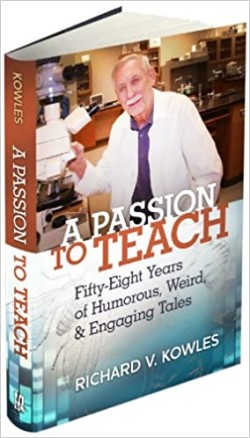


A Passion To Teach: Fifty-Eight Years of Humorous, Weird, and Engaging Tales is mostly a series of stories about the author’s desire to be a teacher, working his way through college with terrible jobs, and teaching for fourteen years in three different high schools before entering resident graduate school pursuing a Ph.D. in genetics. The graduate school episode took place with a wife and five young children and required unbelievable financial craftiness. Much of the book also deals with teaching at the college level following the doctorate degree in genetics, along with chairing a biology department, conducting research, and engaging in scientific communication. Most of the stories are about humorous events; however, a few others are more serious situations. The last three chapters offer personal opinions, viewpoints, and biases regarding pedagogy along with more of the ever presence of fun events and the throes of teaching.
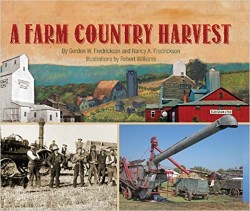

Summer is ending, the grain has been cut, and Jimmy Carlson and his family wait nervously for the arrival of the threshing machine. When it rumbles onto the farm, the whole neighborhood gathers for a long day of spreading shocks, loading, pitching, threshing, and, of course, the threshing feast. But as Jimmy’s family and neighbors work hard to bring in the Carlsons’ precious grain, a few of the boys do some troublemaking of their own. Like the other books in the Farm Country Series, A Farm Country Harvest celebrates the joys and challenges of 1950s farm life. The children’s story, illustrated by Robert Williams, complements two photographic essays celebrating harvest traditions of the past and their preservation by today’s old-time enthusiasts. Readers of all ages can share in the fascination of images capturing harvest work in the 1800s and 1900s, collected by Nancy A. Fredrickson from museums and private collections, and accompanied by Gordon W. Fredrickson’s family stories and interviews with others who have threshing in their blood. A unique celebration of harvest time in farm life, this book draws generations together in a volume sure to become a treasured family heirloom.


Tailored Learning addresses today’s completely changed training realities in a unique way. Readers are offered a fly-on-the-wall perspective as two seasoned learning professionals redesign a traditional, classroom-based new-hire sales training program for a networked, tech-savvy audience. By presenting multiple technology options to a single client in a structured way, readers discover the strengths and weaknesses of multiple solutions. Beginning with a redesign of the existing face-to-face training program to allow the client to truly understand the original objectives of the training program, the book explores various program re-design options using technology solutions to achieve the same learning objectives. The process culminates in the selection of the best blended delivery approach, based on organizational constraints, learner abilities, management support, and the time line necessary to achieve learner success.
April Michelle Davis began indexing this book over the Christmas holidays, providing the completed index in mid-January. Having worked with this client before, April Michelle knew the type of index to write, as well as the key words to pull out from the text. This allowed April Michelle to work on the index more efficiently and quickly and with fewer questions for the publisher.


Inspired by the natural self-healing properties that exist in living organisms―for example, the regenerative ability of humans to heal from cuts and broken bones―interest in self-healing materials is gaining more and more attention. Addressing the broad advances being made in this emerging science, Self-Healing Polymers and Polymer Composites incorporates fundamentals, theory, design, fabrication, characterization, and application of self-healing polymers and polymer composites to describe how to prepare self-healing polymeric materials, how to increase the speed of crack repair below room temperature, and how to broaden the spectrum of healing agent species.
April Michelle Davis copyedited the manuscript in the month leading to publication. This entailed April Michelle working directly with the publisher and ensuring consistency in the publisher’s house style and grammar throughout the manuscript.


Years of disappointment, infertility, and miscarriage behind them, John and Suzanne Henkels finally found bliss. A family began when they joyfully adopted Zach from Russia and was completed when Suzanne gave birth to twins, Jacob and Samuel, two years later.
That ecstasy was shattered when Sammy was given just a 50 percent chance of surviving a rare and brutal disease. The months of treatment – chemotherapy, bone marrow transplant, and devastating complications – put unimaginable pressure on the family. As Sammy struggled for survival, John and Suzanne were frequently separated from their sons, from their home – and from each other.
With rare candor, John writes in Samuel’s Mission of his doubts, fears, and anger – and his search for lost faith. Marriages have been destroyed by far less than what this couple endured. But he and Suzanne learned the meaning of extravagant love and grace – from their family, from the medical professionals, from the children fighting for life, and most importantly, from Sammy – which ultimately opened the
doorway to a life of joy.
April Michelle Davis proofread this manuscript in the weeks before publication. Proofreading is usually performed on a manuscript that has already been through developmental or copyediting and has already been laid out by a designer into page proofs.